

A Level Classical Civilisation
Studying Classical Civilisation gives you an understanding of some of the most engaging literature, architecture and art ever produced, as well of some of the greatest individuals and most significant historical events of the Greek and Roman worlds.

TOP COURSE HIGHLIGHTS
- Enthused students
- Passionate lecturer
- Ancient vocabulary
- Foreign trips
- Revelatory facts

Explore a different past
Classical Civilisation helps you to examine, understand and explain the past from a cultural, archaeological, historical, and literary perspective.

Gods and heroes
Explore and understand the very roots of western civilisation in all its forms, from its first gods and heroes to Augustus, the ‘Godfather of Europe’.

Visit classical sites
Visit Athens and its Acropolis, Mycenae, Epidaurus, Eleusis and magical Delphi in Greece. Visit Rome and see the Pantheon, the Circus Maximus, the Colosseum, and the Senate House in the Roman Forum and walk in the footsteps of giants.
Stepping beyond what’s possible in the classroom
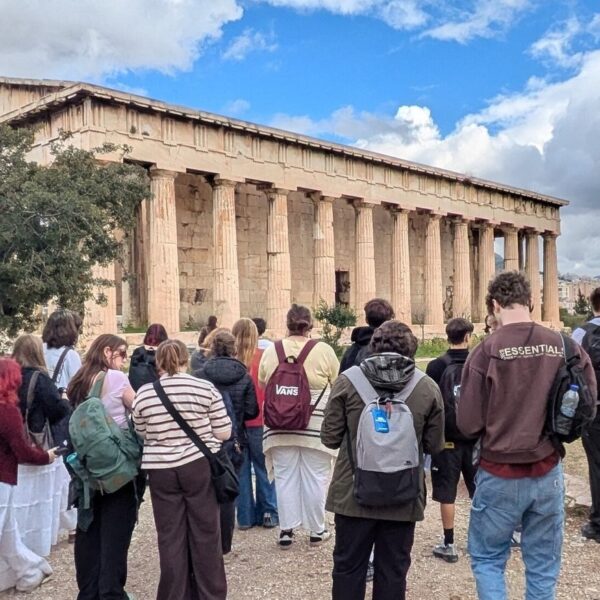
26 lucky A Level Classical Civilisation students travelled to the heart of Western Civilisation, Athens!
From climbing the Acropolis to standing on the Areopagus, wandering the ancient Agora, and exploring the incredible archaeological sites of Eleusis, Corinth Canal, and Piraeus, the ancient world truly came alive.
A special highlight was the visit to Epidaurus, where students stood in one of the most perfectly preserved theatres of the ancient world, part of a sanctuary dedicated to the healing god Asclepius.
Follow us on Facebook to see more of our many international trips here at the College.
WHY CHOOSE THIS COURSE?
Classical Civilisation is an engaging course that explores aspects of ancient Greek and Roman culture: literature, mythology, war, propaganda, archaeology, architecture, art, philosophy, and society. In many respects ancient Greece and Rome were the harbingers of what we call “civilisation”, and their legacy continues to this day in all aspects of our daily life. The combined effects of Greek and Roman culture have long inspired academics as well as interested readers to delve deeply into their culture, resplendent as it is in warrior heroes, philosophers, literary geniuses, and architectural innovators. This course is an opportunity to explore the first great western civilisations and understand the impact they still have on western culture in particular, especially regarding language, history, philosophy, architecture, theatre, and politics.
The study of Classical Civilisation is also the study of beginnings: of western literature with Homer; of theatre with Sophocles and Euripides; of History with Herodotus and Thucydides; of medicine with Asclepius and Hippocrates; of architecture with Pheidias; of great individuals such Pericles, Julius Caesar and Augustus; of empire with the Greeks and Romans; of military tactics, with the Greek phalanx and the trireme; of propaganda with Augustus.
WHAT WILL I LEARN?
The 3 modules comprising the A Level are as follows: Module 1: ‘The World of the Hero’, an in-depth study of Homer’s ‘Iliad’ and Virgil’s ‘Aeneid’; Module 2: Beliefs and Ideas; ‘Greek Religion’; Module 3: Culture and the Arts, ‘Imperial Image’; an in-depth study of the literature and visual culture of Augustan Rome.
The units enable students to develop a range of interpretive, analytical and evaluative skills. Module 1 is focused on the heroes and culture encapsulated in Greek and Roman Epic literature; Module 2 is a study of the religious beliefs and practices of the Greeks, Module 3 studies the history of Augustan Rome and the propaganda used by Augustus to legitimise his reign as Princeps.
WHERE WILL IT TAKE ME?
This A Level is a highly regarded qualification by both Higher Education establishments and employers. You could go on to study a range of Classics degree courses or related courses at University level. You will gain access to careers including business, law, media, journalism and politics as well as career pathways involving historical skills.
Degrees such as Latin and/or Greek, Classical Civilisation or Classical Studies are offered at all Russell Group universities. After training in their particular area of specialism which may involve Classical history, archaeology, theatre, architecture, numismatics, literature or ancient languages, many students opt for further study, extending their knowledge by progressing onto a Masters in subjects such as Egyptology, and even progress to study for their PhD
Some career options include barrister, chartered accountant, civil servant, editorial assistant, novelist, fine art specialist, heritage manager, curator, archaeologist, market researcher, archivist and even lecturer.
You will be formally examined on each unit that you study. The examinations are at the end of the second year and comprise Unit 1, The World of the Hero: 2 hrs 30 mins, (40%) and Unit 2, Greek Religion and Unit 3 Imperial Image both of 1hr 45 mins (30% each).
Five GCSEs at Grade 4 or above with a Grade 6 in English (preferably English Literature) or a Humanities subject.
Your achievement in this subject is dependent upon excellent attendance, punctuality and effort. You will learn in a friendly atmosphere, using a variety of assessment methods: You will be assessed regularly on written essay work that is conducted either as homework or under timed conditions in class and given feedback on your progress. Discussions are a vital part of our assessment process and you will be expected to contribute to those and reading exercises. Personal research and reading of modern scholarship is also a requirement. You will review your own performance in a 1:1 session with your tutor. You will undertake mock examinations on each unit in advance of your final exams. An enjoyment of reading is essential, as besides two Epic Poems, there is a requirement to read modern scholars’ and their interpretations.
If you have any questions please contact Stuart Falconer, Classical Civilisation Lead, at stuartf@truro-penwith.ac.uk
Do I need to have studied GCSE History?
No, you do not, however, we do analyse sources so it would come in useful.
Do I need to have studied Latin or Greek?
No, you do not. We learn some vocabulary from both languages, but not the languages themselves and there is no expectation or need for any student to have studied either.
Are there any foreign trips?
Our intention is to visit Athens, Delphi, the Argolid and Rome every year, depending on travel restrictions and numbers.
Is there any reading I can do in advance?
Anything on the Trojan War, such as Michael Wood, ‘In Search of the Trojan War’; Stephen Fry, ‘Troy’, ‘Heroes’, ‘Mythos’; can be useful as context for Homer’s Iliad and or Paul Cartledge, ‘Religion in the Ancient Greek City’ as an introduction to Greek Religion.


