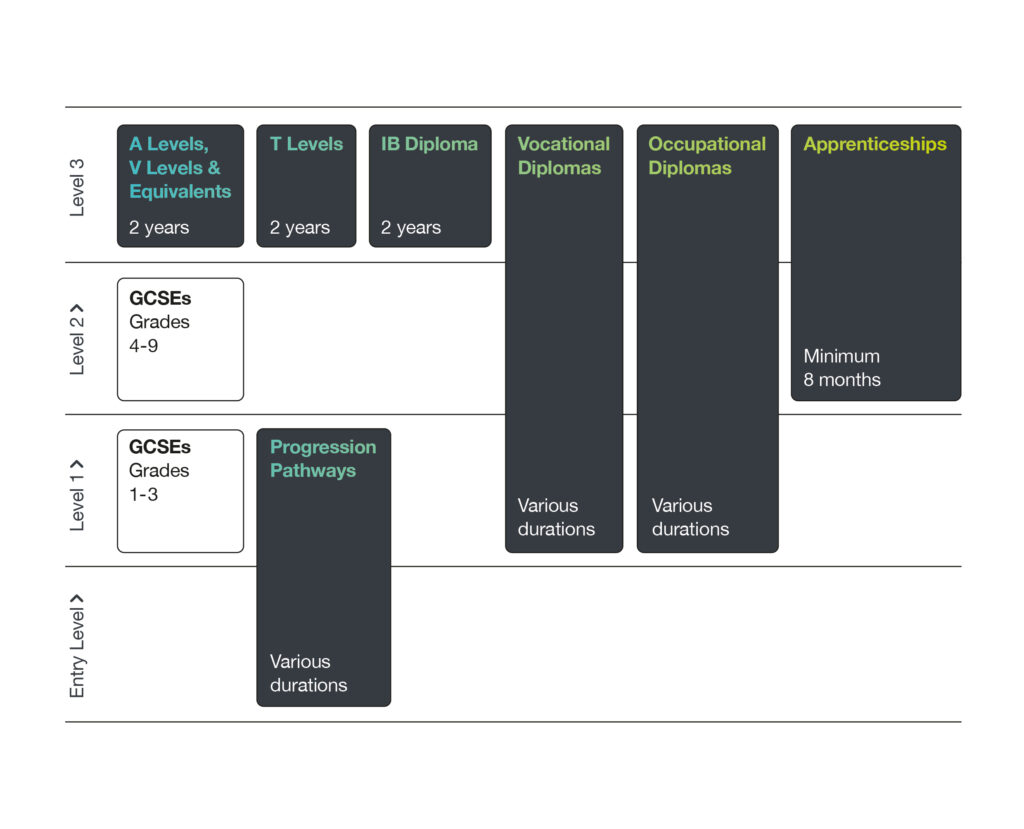
A Levels, V Levels & Equivalents
Choose three courses. Ideal for keeping your options open or choosing university-focused combinations.
A Levels are knowledge-based qualifications assessed at the end of two years.
V Levels, AAQs and Extended Certificates are equivalent to one A Level but are more skills and career focussed. They are assessed throughout your course and can be mixed with A Levels.
What you’ll need: Five GCSEs at Grade 4 or above. Grades 5 and 6 will be required in certain subjects. See individual course pages for specific requirements.
T Levels
A full-time qualification equivalent to three A Levels, combining classroom learning with a 45-day industry placement.
What you’ll need: Entry requirements vary by course, but most require four GCSEs at Grades 4/5 or above, including English and Maths. A relevant Level 2 Diploma at Merit may also be accepted.
IB Diploma
An excellent broad-based alternative to A Levels, allowing you to study six subjects The IB is widely accepted by universities.
What you’ll need: Five GCSEs at Grade 4 or above, including English and Maths at Grade 5, plus Grade 6 in subjects linked to your Higher Level choices.
Vocational
A full-time, career-focused course in a single subject. Level 3 qualifications are equivalent to three A Levels.
What you’ll need:
- Level 1: No prior qualifications required.
- Level 2: Three GCSEs at Grade 3, including English and/or Maths.
- Level 3: Four GCSEs at Grade 4, including English and/or Maths, or a relevant Level 2 Diploma at Merit.
Occupational
Specialist industry skills based courses. Entry to a Level 3 Diploma requires completion of a relevant lower-level qualification.
What you’ll need:
- Construction Level 1: Two GCSEs at Grade 2, including English and/or Maths.*
- Motor Vehicle Level 1: Three GCSEs at Grade 2, including English, Maths and Science.*
- Hair, Beauty & Catering Level 1: Three GCSEs at Grade 2, including English and/or Maths.
- Hair, Beauty & Catering Level 2: Three GCSEs at Grade 3, plus English and/or Maths at Grade 4.
* These grades are desirable but all will be considered following a successful interview.
Apprenticeships
Earn while you learn, gaining valuable workplace experience, practical skills and nationally recognised qualifications.
What you’ll need: Entry requirements vary by apprenticeship standard. Available to anyone aged 16+. Start dates throughout the year, with the majority of apprenticeships starting in October.
Progression Pathways
For learners working at entry levels, who may also have SEND (Special Educational Needs or Disabilities).
What you’ll need: No formal qualifications required. Your EHCP and initial assessments will help determine the most suitable course for you.